← Vivara Intelligence How it Works Under the Hood Screenshots Features Tech Stack Request a Demo
🔍 M&A & Investment Due Diligence

Read the entire
data room in minutes,
not weeks.

DiligenceAI ingests contracts, financials, and technical documents, then extracts, cross-references, and verifies facts across the whole document set — surfacing deal scores and generated reports instead of leaving analysts to read everything by hand.

Built for the deal that outgrew a data room folder

Small and mid-sized companies rarely have clean, audit-ready records. By the time a deal is on the table, the data room is often 1,500–2,000+ documents scattered across several years — financial statements in one format one year and another the next, contracts filed by whoever was around at the time, HR records in three different spreadsheets. Working through that by hand usually means bringing in an M&A specialist or a small deal team, at real cost and on a timeline measured in weeks.

DiligenceAI is built for exactly that mess — not a clean, well-organized enterprise data room, but the kind smaller companies actually have. It reads everything once, keeps every fact traceable to its source document and page, and gives a deal team a structured, cross-checked starting point in hours instead of weeks — without replacing the judgment a specialist still needs to apply to what it finds.

1,500–2,000+
Typical scattered documents in an SMB data room
Multi-year
Inconsistent formats across financial years
Hours, not weeks
To a structured, cross-checked first pass

From raw documents to a verified deal view

Six stages, each with its own engine — not a single prompt wrapped around your files.

1

Ingest & chunk

PDFs and Word documents go through a page- and heading-aware chunker; Excel workbooks go through a purpose-built financial-statement parser.

2

Embed & index

Every chunk is embedded with a finance-tuned model and indexed in Postgres with pgvector — no separate vector database to run.

3

Analyze per workstream

Six specialist personas — Financial, Legal, Commercial, HR, Cybersecurity, Technology — each run independently against multiple LLM providers.

4

Reconcile across models

Findings from every provider are embedded, matched by cosine similarity, and checked for severity agreement or conflict.

5

Score the deal

A deterministic rules engine turns verified facts and risk ratings into category scores and an overall, auditable deal score.

6

Generate the report

Sections run in dependency order — Executive Summary only runs after P&L, Balance Sheet, and Key Risks are validated — into an exportable report.

What actually happens to your documents

The engineering behind each stage — not a black box.

01

Document processing & chunking

A dedicated document-intelligence service parses PDFs and Word files using structure-aware chunking, so every chunk keeps its page number and a heading breadcrumb (e.g. Financials > Revenue > Q3) — the same trail a human analyst would follow. Excel workbooks — trial balances, cap tables, HR rosters — don't go through generic OCR. A separate statistical parser scores each row to detect header rows and classifies every sheet (transaction log, financial statement, summary, notes) before it's chunked, because spreadsheets break document parsers built for prose.

02

Vector storage & retrieval

Chunks are embedded with a finance-domain-tuned model and stored directly in Postgres using the pgvector extension — no separate vector database to provision or keep in sync. Retrieval runs cosine similarity through an HNSW index and ranks results with a partition-aware window function, so relevant chunks from every document surface together instead of one large file dominating the results. If embedding APIs are ever unavailable, retrieval falls back automatically to keyword search rather than returning nothing.

03

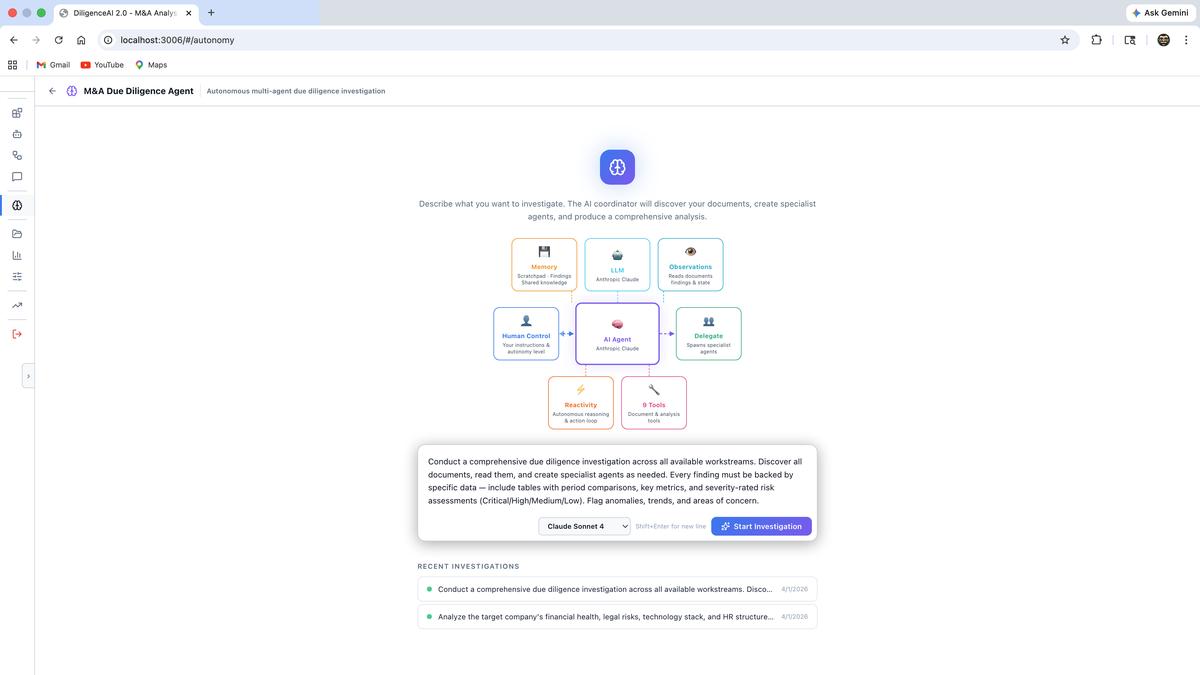
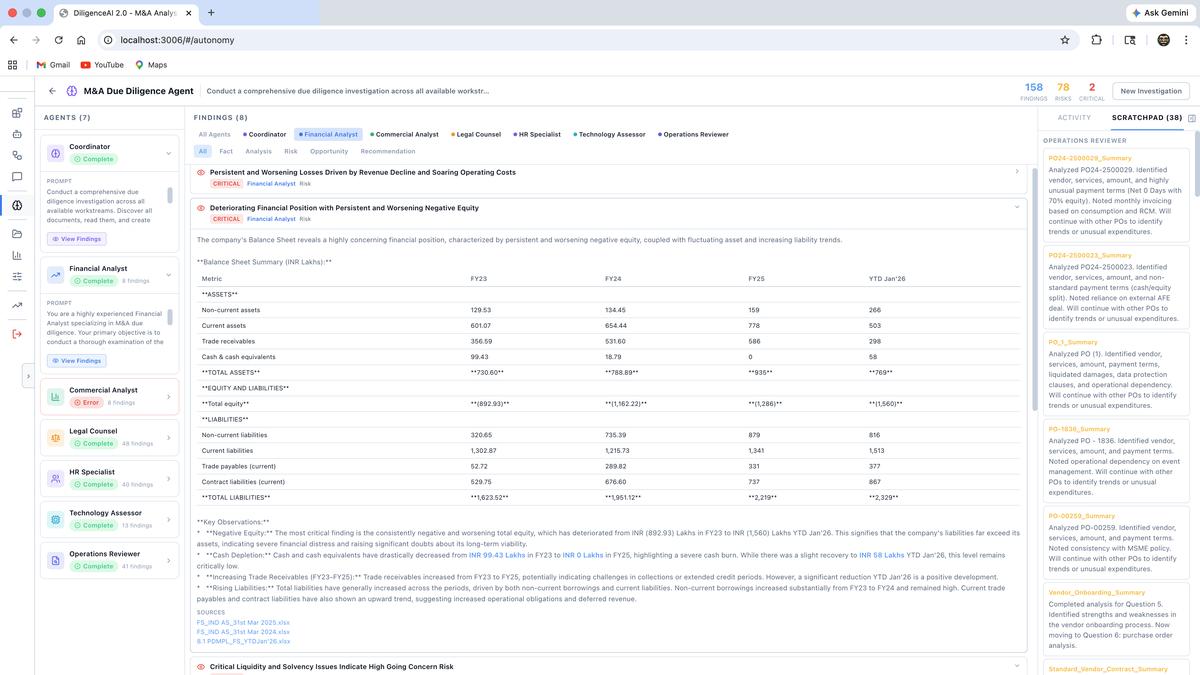
Multi-persona LLM orchestration

Due diligence isn't one question — it's six. DiligenceAI runs Financial, Legal, Commercial, HR, Cybersecurity, and Technology as independent personas, each with its own prompt, search strategy, and output schema, configurable per deal rather than hardcoded. Every persona can run against Anthropic Claude, OpenAI GPT, and Google Gemini independently — up to eighteen parallel analyses across a single data room. Numeric figures are extracted deterministically first and pre-filled into the output schema before any model sees the prompt, so the LLM's job is judgment and narrative, not recalling or computing numbers.

04

Two ways to run an analysis

DiligenceAI supports two complementary modes, and most deals use both. The persona mode is the fast path: point it at a data room, assign personas — Financial Analyst, Legal Counsel, Commercial Analyst, whoever the deal needs — and get back a comparative analysis across every LLM provider you've enabled, with no report structure to configure up front.

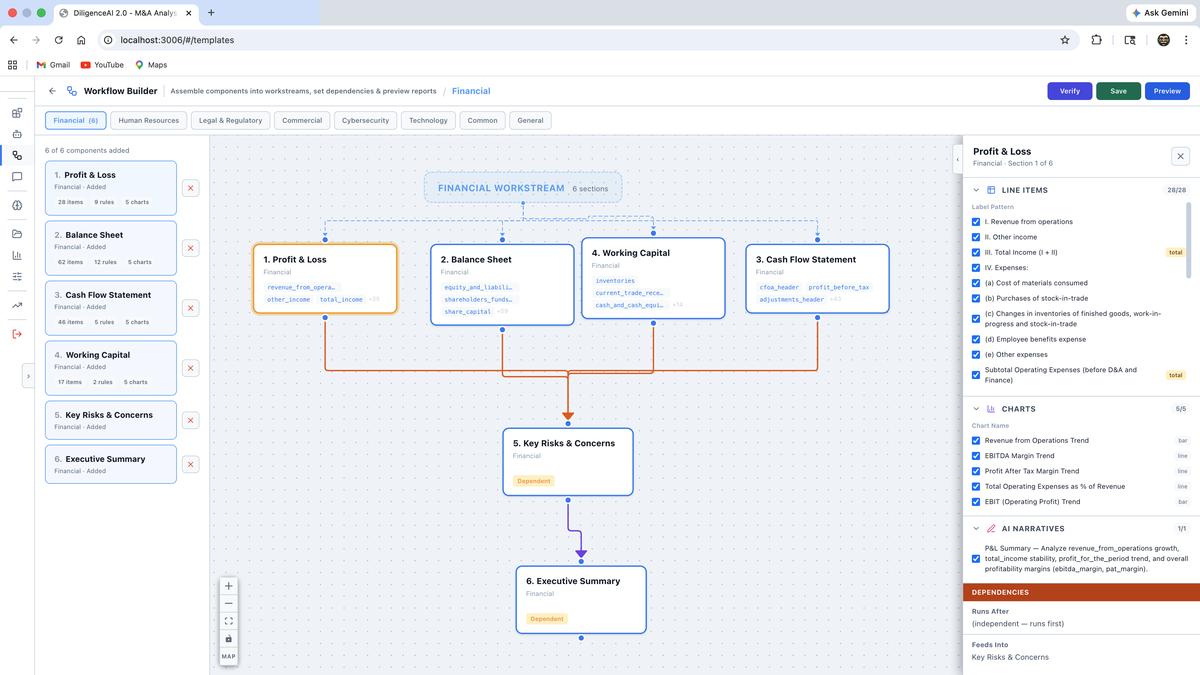
The component mode is the precise path, for when a deal needs a specific, repeatable structure. Each piece of the report — Balance Sheet, Trial Balance, Cash Flow Statement, Working Capital, Key Risks — is built as its own component, with its own line-item schema, its own extraction rules, and its own agent configuration. Components declare what they depend on, so Executive Summary knows it needs Balance Sheet and Key Risks to finish first. Once built, a set of components becomes a reusable template — assemble it once for, say, a SaaS acquisition, and every future SaaS deal runs the same structured analysis instead of starting from a blank prompt.
05

Cross-model matching & agreement scoring

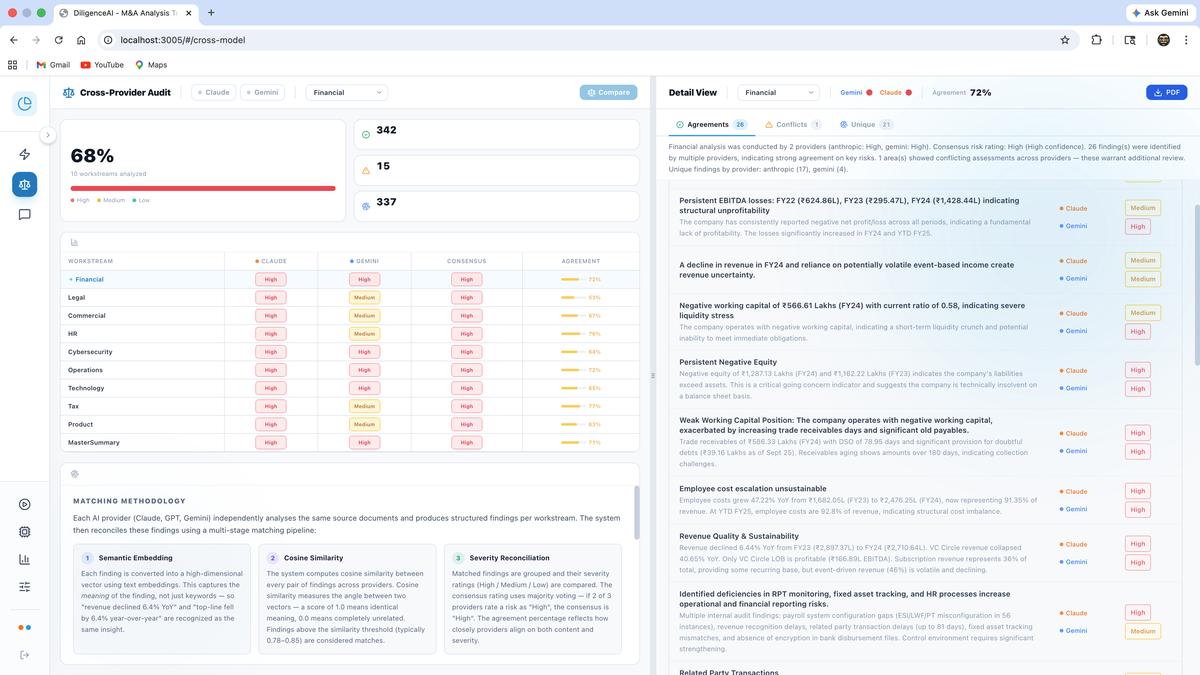
Every workstream is analyzed by more than one model, and the outputs rarely say exactly the same thing in exactly the same words — so DiligenceAI doesn't compare text, it compares meaning. Each finding from each provider is embedded, and every pair of findings across providers is scored with cosine similarity; pairs above threshold are matched. Matched findings are then checked for severity agreement — if one model calls something "Medium" and another calls it "Critical," that's flagged as a conflict rather than silently averaged. If the embedding step is unavailable, matching degrades gracefully to token-overlap comparison instead of failing outright.

The result is a per-workstream agreement score and a consensus confidence rating — unanimous agreement across all providers reads as High confidence, a 2-of-3 majority reads as Medium, and a genuine 3-way split reads as Low and defaults to the highest-severity read. Nothing here is a single model's opinion presented as fact — you can see exactly where Claude, GPT, and Gemini agreed, where they didn't, and how confident the system is in the result.

06

Deal scoring

The deal score is a deterministic, rules-based calculation — not an LLM guess. Five category scores (Financial, Commercial, Legal, People, Tech/Cyber) roll up into a weighted overall score, with configurable weights per deal. Specific financial conditions apply real caps: negative EBITDA caps the Financial score, three or more workstreams rated High risk cap the overall deal score regardless of everything else. Every adjustment is logged in plain language — "Churn 34% > 30% threshold → Commercial capped at 40" — so the score is auditable, not a black box.

07

Template-driven report generation

Reports are built from a dependency graph, not a flat template. Sections like Executive Summary and Key Risks explicitly declare which upstream sections — Profit & Loss, Balance Sheet, Human Capital — they depend on, and only generate once those sections are complete and validated. Every section's AI output is checked against the pre-verified source numbers; a mismatch triggers an automatic re-generation before it's accepted into the report. Templates are stored as full node-and-edge graphs and can be cloned per industry, so the same engine handles a SaaS acquisition and a manufacturing vendor review differently.

The workbench analysts actually use

A closer look at the workflow builder, agent orchestration, and findings review.

Built for real diligence workflows

A structured analysis pipeline for document-heavy diligence work.

🎭

Persona & component modes

Run a fast persona-based analysis with no setup, or build reusable components — Balance Sheet, Trial Balance, Key Risks — into a structured, repeatable template.

🧩

Multi-provider orchestration

Every workstream can run against Anthropic Claude, OpenAI GPT, and Google Gemini independently, not just one model with a single point of view.

📐

Cosine-matched agreement

Findings from every model are embedded and compared by cosine similarity, then scored for agreement and consensus confidence — not just concatenated.

🔗

Cross-document fact mapping

Every extracted fact is traced back to its source page and reconciled against every other document mentioning it.

📈

Auditable deal scoring

A deterministic rules engine — not an LLM guess — rolls up verified facts into category and overall deal scores, with every adjustment logged.

💬

Chat over your data room

Ask questions directly against the ingested document set and get answers grounded in retrieved, cited source text.

Under the Hood

Frontend

  • React 19 + TypeScript
  • Vite, React Router
  • Node-based workflow builder UI

Backend

  • Node.js + Express (TypeScript)
  • PostgreSQL, WebSockets
  • Python document-intelligence microservice

AI

  • Multi-provider: Anthropic, OpenAI, Gemini
  • Postgres + pgvector, HNSW cosine search
  • Finance-tuned embeddings (Voyage AI)
  • Structured, high-fidelity document parsing

Curious how DiligenceAI would handle your data room?

We're onboarding early design partners for due diligence and vendor evaluation workflows.

Get in Touch